M.Sc. GPA18.21 / 20Electrical Engineering
Curriculum Vitae
Academic CV
M.Sc. graduate in Electrical Engineering – Micro and Nano Electronic Devices, with research experience in computational photonics, photonic-crystal device design and sensing, and PWE/FDTD simulation. Sole author of a peer-reviewed article on photonic-crystal sensing.

2026SOI microring project2024Peer-reviewed publication2021M.Sc. completed
Thesis grade17.99 / 20Pressure-sensor research
Publication1Sole-authored journal article
Open-source project1SOI microring workflow
Research Profile
Research interests
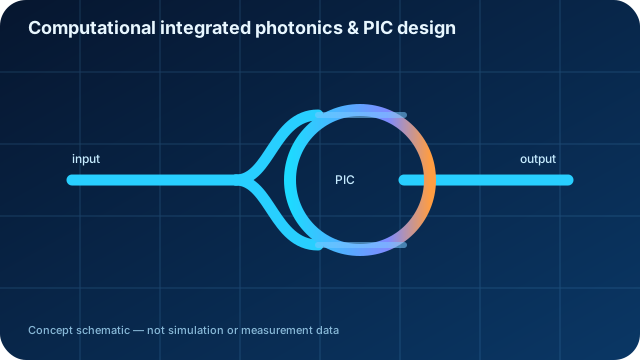 Computational integrated photonics and photonic integrated
circuit (PIC) design
Computational integrated photonics and photonic integrated
circuit (PIC) design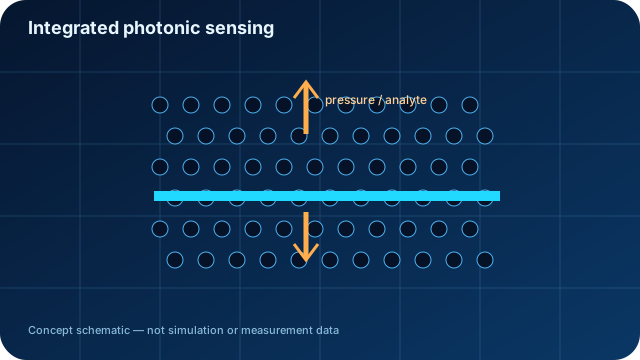 Integrated photonic sensors based on photonic crystals,
microresonators, and waveguides
Integrated photonic sensors based on photonic crystals,
microresonators, and waveguides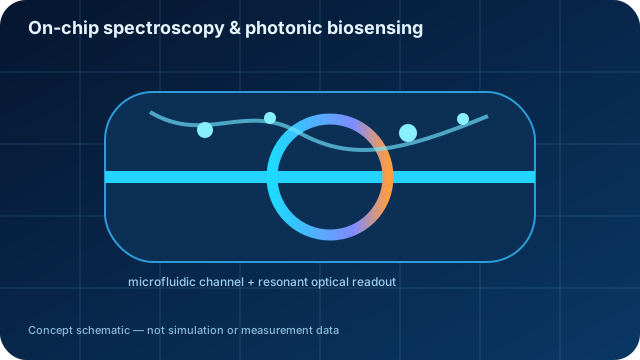 On-chip spectroscopy and optofluidic/lab-on-chip photonic
biosensing
On-chip spectroscopy and optofluidic/lab-on-chip photonic
biosensing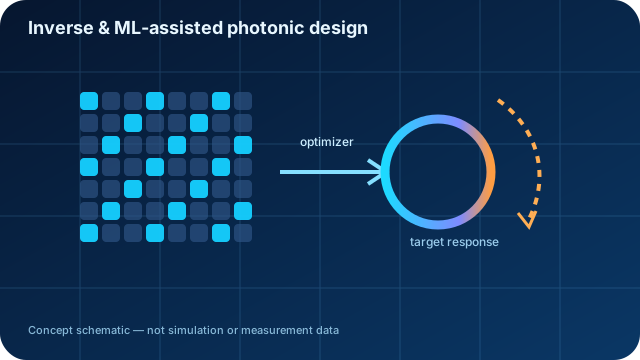 Photonic inverse design and data-driven/ML-assisted
optimization, including adjoint and topology-optimization
methods
Photonic inverse design and data-driven/ML-assisted
optimization, including adjoint and topology-optimization
methods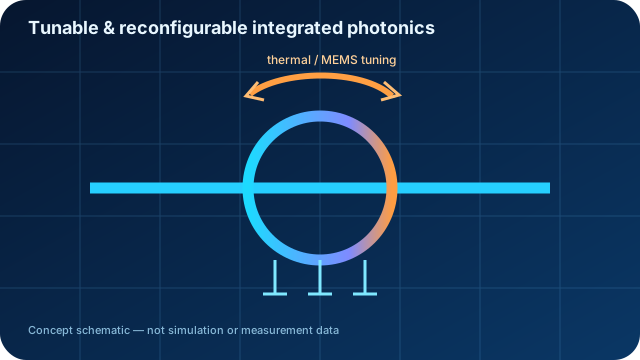 Tunable and reconfigurable integrated photonics, including
MEMS-enabled photonic devices
Tunable and reconfigurable integrated photonics, including
MEMS-enabled photonic devices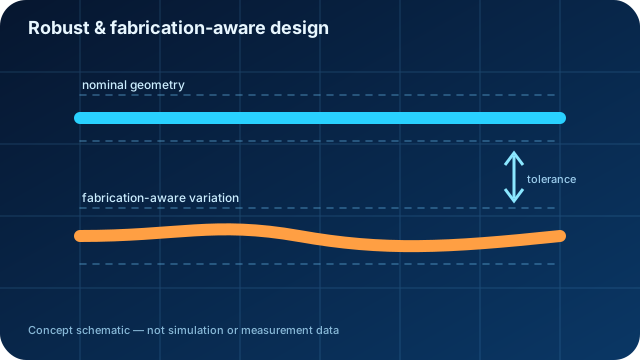 Robust and fabrication-aware design of integrated photonic
devices and circuits
Robust and fabrication-aware design of integrated photonic
devices and circuits
Education
Academic background
Master of Science
Electrical Engineering – Micro and Nano Electronic Devices
2017–2021
Islamic Azad University, Tabriz Branch · Tabriz, Iran
- GPA
- 18.21/20
- Master's thesis grade
- 17.99/20
Master's thesis
Design and Simulation of Waveguide Structure Based on Coupled Cavities for Pressure Measurement
Supervisor: Hamed Alipour, Ph.D.
Selected coursework
- Quantum Electronics — 20/20
- Semiconductor Devices — 20/20
- Optical Electronics — 19/20
- Special Topics: Photonic-Crystal Integrated Circuit Design (PWE, FDTD, RSoft) — 19/20
- Nanoelectronics — 18/20
- CMOS Integrated Circuits — 18/20
Bachelor of Science
Optics and Laser Engineering – Optoelectronics
2013–2017
Islamic Azad University, Tabriz Branch · Tabriz, Iran
Relevant coursework
Electromagnetism I–II; Electronics I–II; Quantum Mechanics for Optics and Laser; Optoelectronics; Physics of Semiconductor Devices; Integrated Optical Circuits; Wave Optics; Laser I–II; Sources and Detectors.
Research Experience
Research development
Thesis-to-Publication Development
Polymer-Based Photonic Crystal Pressure Sensor
2023–2024
- Developed the M.Sc. research into a journal manuscript by adapting the pressure-sensor model to a polymer-based photonic-crystal slab and revising the material assumptions for the publication-stage study.
- Presented systematic cavity-radius sweeps and analyzed resonance shifts, quality factor, transmission, and pressure sensitivity using PWE/FDTD-based simulations.
- Revised methodology, technical explanations, figures, literature comparison, and discussion in response to multi-reviewer feedback.
- Published the revised work as sole author in Optical and Quantum Electronics in 2024.
Master's Thesis Research
Coupled-Cavity Photonic Waveguide Pressure Sensor
2021
- Modeled and systematically modified a coupled-cavity photonic-crystal waveguide pressure-sensor architecture using RSoft, plane-wave expansion (PWE), and finite-difference time-domain (FDTD) methods.
- Investigated cavity geometry, coupling, resonance behavior, and pressure-dependent optical response through systematic radius variation.
Peer-Reviewed Publication
Journal article
Design, simulation, and optimization of a polymer-based photonic crystal pressure sensor
Optical and Quantum Electronics 56, 654 (2024)
DOI: 10.1007/s11082-024-06337-3
Selected Computational Project
Reproducible SOI Add-Drop Microring Resonator
Independent Computational Photonics Project
Ansys Lumerical + Python
2026
- Developed a reproducible SOI add-drop microring workflow covering waveguide-mode analysis, convergence checks, group-index/FSR estimation, bend-radius characterization, coupling-gap screening, and full-ring simulation.
- Selected simulated design: R = 10 µm; gap = 200 nm; median FSR = 8.005 nm; median loaded Q = 2215; median extinction ratio = 11.79 dB.
Technical Skills
Computational and research toolkit
- Photonics simulation and design
- RSoft (BandSOLVE, FullWAVE); Ansys Lumerical MODE/varFDTD (project-based experience in waveguide-mode analysis and convergence checks); OptiFDTD; OptiSystem
- Multiphysics simulation
- COMSOL Multiphysics (basic familiarity)
- Programming and numerical computing
- MATLAB; Python (basic; used for Lumerical automation, post-processing, and data analysis)
- Data handling and analysis
- Microsoft Excel — formulas, PivotTables, and data analysis
- Technical documentation
- Microsoft Word — styles, equations, references, and document formatting
- Scientific presentations
- Microsoft PowerPoint — technical presentations, figures/charts, and speaker notes
- Database tools
- Microsoft Access — tables, queries, forms, and reports
- Research methods
- FDTD; PWE; photonic-crystal cavity and waveguide modeling; resonance and band-structure analysis; systematic parameter sweeps; geometry optimization
- Research practice
- Simulation post-processing; data visualization; scientific writing; manuscript preparation; and manuscript revision in response to peer review
Academic Support
Academic contribution
Informal Academic Support – Special Topics in Photonic-Crystal Integrated Circuit Design
Islamic Azad University, Tabriz Branch
Fall 2018
Provided informal academic support on photonic-crystal circuit design, PWE and FDTD concepts, and RSoft-based simulation workflows.
Certifications
Technical training
31 Aug 2019
MATLAB Programming Certificate
Iran Technical and Vocational Training Organization (Iran TVTO)
Training provider: Tabriz Technical Complex
Credential ID: 251140530900031
01 Sep 2023
Lumerical Software Training Certificate
Optics, Photonics and Electronics Training Group (OPFA)