Journal articles1Peer reviewed
Publications
Peer-Reviewed Research
Published research in computational photonics and photonic-crystal sensing, with emphasis on numerical design, simulation, and device optimization.
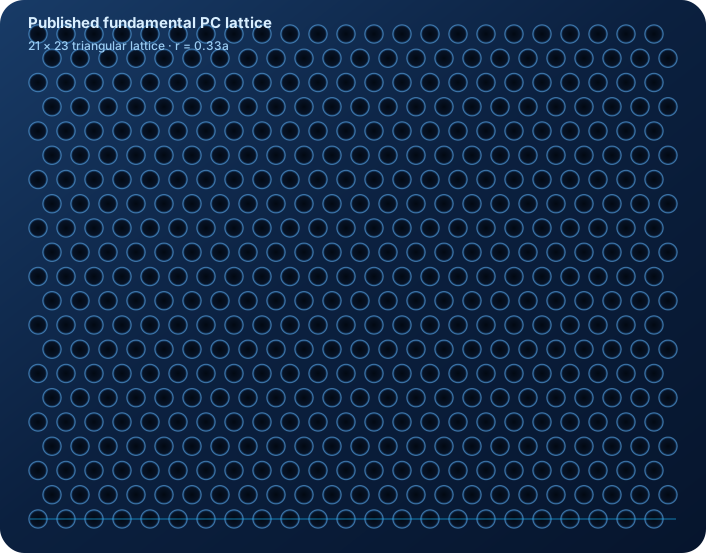
Q29,363T0.98S0.021 µm/GPa
Reported values from the published articleAuthorshipSole authorAyda Lotfi Hayaei
Published2024Optical and Quantum Electronics
Article56 · 654DOI linked
Journal Article · 2024
Design, simulation, and optimization of a polymer-based photonic crystal pressure sensor
Optical and Quantum Electronics
Publication record
Research Summary
Polymer-based photonic-crystal pressure sensing
The study investigates a pressure sensor based on a polymer photonic-crystal slab. Pressure-dependent changes in the sensing structure and refractive index are evaluated through shifts in resonance wavelength.
The photonic structure is numerically optimized by varying geometric parameters and evaluating the resulting optical response. The optimized device is then studied across different applied pressures to characterize its sensing performance.
The optical analysis combines finite-difference time-domain simulation with plane wave expansion methods for resonance and photonic-band-structure evaluation.
Reported Performance
Key numerical results
Values below are the performance figures reported for the optimized sensor in the published article.
- Quality factor
- 29,363
- Transmission
- 0.98
- Pressure sensitivity
- 0.021 µm/GPa
- 21 nm/GPa
Methods
Computational approach
01
Photonic-crystal structure
A polymer-based photonic-crystal slab provides the optical platform for pressure-dependent resonance sensing.
02
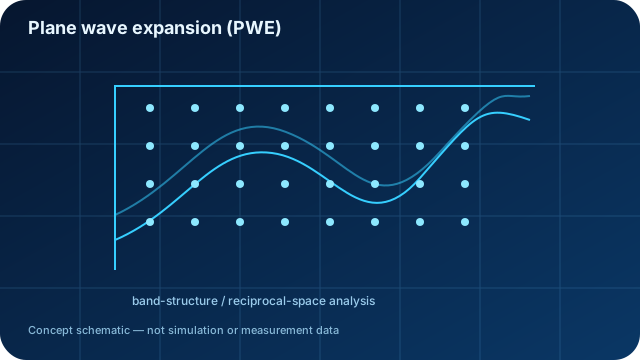
Plane wave expansion
Plane wave expansion is used to investigate the photonic band structure and relevant propagation characteristics.
03
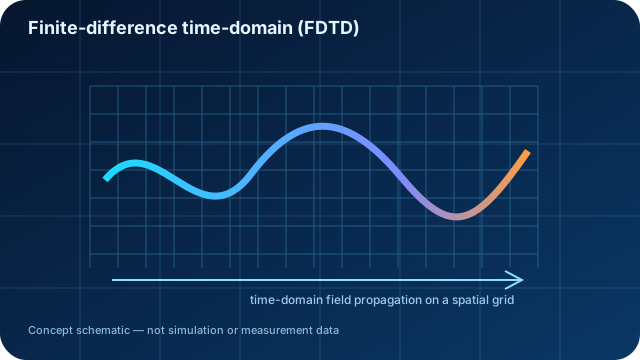
FDTD simulation
Finite-difference time-domain simulations are used to evaluate resonance behavior, transmission, and sensing response.
04
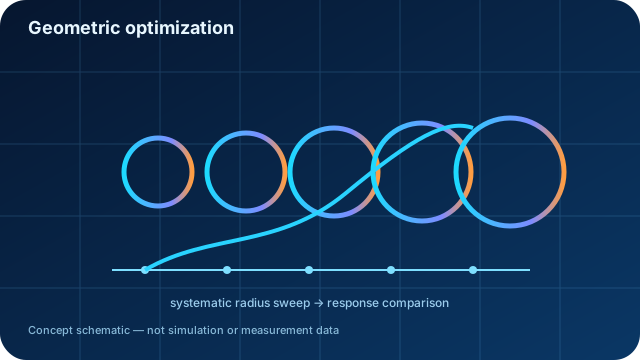
Geometric optimization
Structural radii are systematically varied to identify an optimized configuration for the sensing device.
Article Keywords
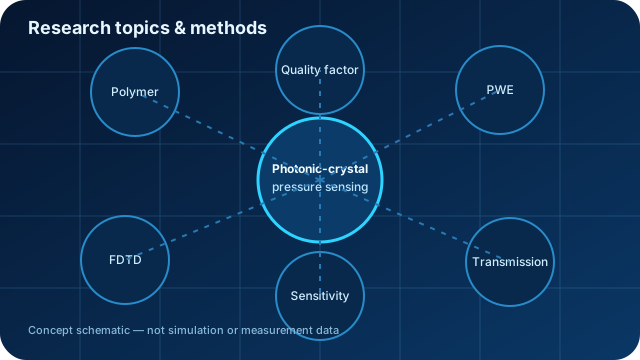
Research topics and methods
- Polymer
- Photonic crystal slab
- Pressure sensor
- Sensitivity
- Quality factor
- Transmission
- Finite-difference time-domain
- Plane wave expansion
Citation
Recommended citation
Lotfi Hayaei, A. Design, simulation, and optimization of a polymer-based photonic crystal pressure sensor. Optical and Quantum Electronics 56, 654 (2024).
DOI: 10.1007/s11082-024-06337-3